Pot odds turn a poker call into a comparison: how much must you put in, and how large will the pot be if you call? A quick calculation can help you judge whether a call is mathematically reasonable. It cannot guarantee a result, but it gives you a clearer basis for deciding than simply hoping to improve.
Start with the call price and the final pot
Use two numbers: the amount you need to call and the pot size after your call. Divide the call amount by that final pot to get the minimum equity you need, expressed as a percentage.
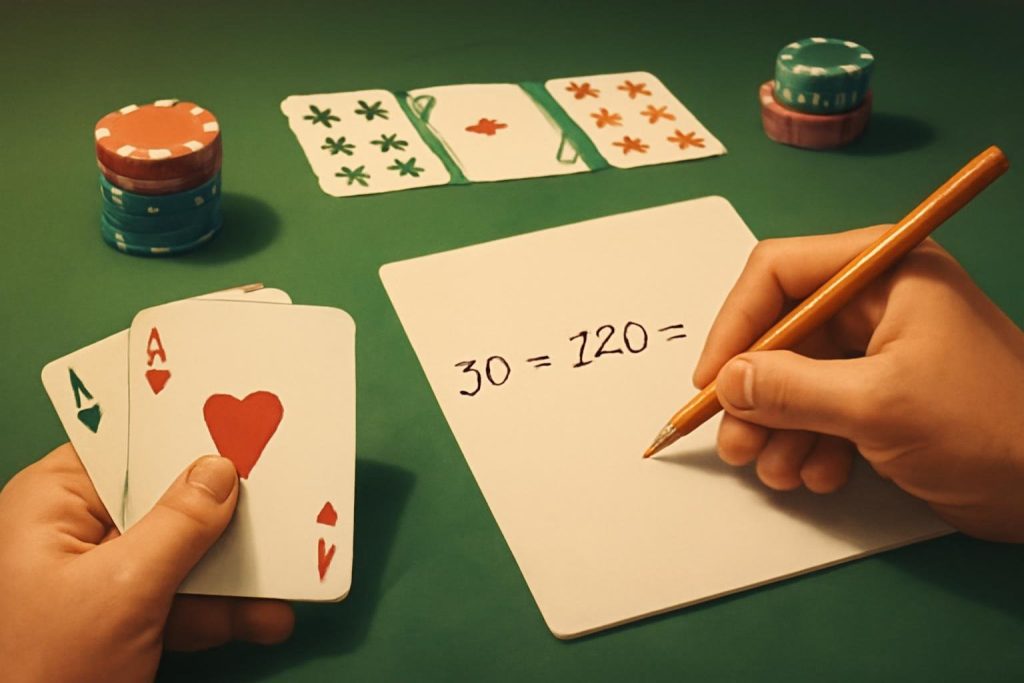
For example, imagine the pot is 60 chips and an opponent bets 30. The pot is now 90, and calling costs 30. If you call, the final pot will be 120. So the calculation is 30 ÷ 120 = 0.25, or 25%. In this simplified example, your hand needs to win at least one time in four to make the call break even in the long run, before considering other factors.
The same situation can be described as pot odds of 3-to-1: there are 90 chips to win for every 30 you must call. The ratio and percentage are two ways to express the same comparison.
Use a shortcut when the numbers are easy
You do not need a calculator for every decision. If the call is one-quarter of the final pot, you need 25% equity. If it is one-third, you need about 33%. If it is one-fifth, you need 20%. These are reference points, not a substitute for accurately identifying the pot and call size.
- Pot is 80; opponent bets 40: Calling 40 makes the final pot 160. The call is one-quarter of that pot, so the threshold is 25%.
- Pot is 100; opponent bets 100: Calling 100 makes the final pot 300. The call is one-third of the final pot, so the threshold is about 33%.
In a live hand, take a moment to count the current pot and separate the opponent’s bet from the amount you need to call. A common slip is to divide by the pot before calling, which leaves out the chips you would add.
Compare the threshold with your chance of winning
Pot odds tell you the equity threshold; they do not tell you your actual equity. For that, consider the cards your hand could improve to, what hands your opponent might hold, and whether some of your apparent outs could help the opponent too. An “out” is a card that may improve your hand enough to win, but not every possible improvement is clean or guaranteed to be best.
Suppose your estimate is that you have roughly a 25% chance to win, and the pot-odds threshold is also 25%. On the simplified numbers, the call is around break-even before other costs and future decisions. If your chance is clearly lower, the immediate price is less attractive; if it is higher, the price may be favorable. These estimates are uncertain, especially when an opponent’s range is wide.
For foundational rules and hand rankings, see this beginner’s guide to poker. Once a session is over, reviewing specific decisions can help you see whether your estimates were consistent; this guide to reviewing hand histories offers a practical process.
Remember what the quick calculation leaves out
Pot odds are a snapshot of the current decision, not a promise about the rest of the hand. A call can lead to another bet on a later street. Your hand may also be difficult to play even when it improves, while a strong draw may sometimes win without making its draw. Those possibilities affect how useful your equity is in practice.
In games with a rake, the amount ultimately available to win can be lower than the displayed pot. In a tournament, chips also have strategic value beyond their face amount, so a chip-based calculation may not capture every consequence. Treat the basic percentage as a starting point rather than a complete strategy.
A short decision checklist
- What is the pot size, and exactly how much is the call?
- What will the final pot be if you call?
- What equity threshold does the call require?
- Are your likely outs clean, and could later bets change the decision?
- Are you choosing calmly within limits you set before playing?
The useful habit is not doing difficult arithmetic at speed. It is asking the same clear questions each time, then accepting that even a well-priced call can lose. Poker involves financial risk; play only where legal, and never stake money you need for essentials.

